Description
| Material | Chrome Steel |
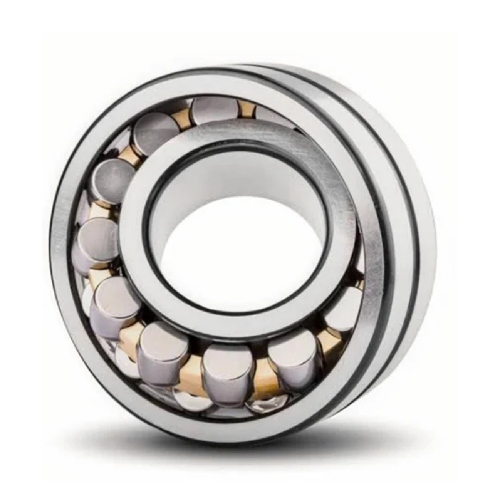
A spherical roller bearing is a rolling-element bearing that permits rotation with low friction, and permits angular misalignment. Typically these bearings support a rotating shaft in the bore of the inner ring that may be misaligned in respect to the outer ring. The misalignment is possible due to the spherical internal shape of the outer ring and spherical rollers. Spherical roller bearings consist of an inner ring with two raceways inclined at an angle to the bearing axis, an outer ring with a common spherical raceway, spherical rollers, cages and, in certain designs, also internal guide rings or center rings. These bearings can also be sealed.

| Material | Chrome Steel |
A ball bearing is a type of rolling-element bearing that uses balls to maintain the separation between the bearing races. Common ball bearing designs include angular contact, axial, deep-groove, and preloaded pairs. The balls in ball bearings can also be configured in various ways. Ball bearings are used in a wide range of applications, some of which include skateboards and centrifugal pumps. Ball bearings tend to have lower load capacity for their size than other kinds of rolling-element bearings due to the smaller contact area between the balls and races. However, they can tolerate some misalignment of the inner and outer races.
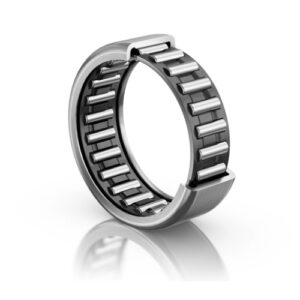
A needle roller bearing is a special type of roller bearing which uses long, thin cylindrical rollers resembling needles. Ordinary roller bearings’ rollers are only slightly longer than their diameter, but needle bearings typically have rollers that are at least four times longer than their diameter. Like all bearings, they are used to reduce the friction of a rotating surface. Compared to ball bearings and ordinary roller bearings, needle bearings have a greater surface area in contact with the races, so they can support a greater load. They are also thinner, so they require less clearance between the axle and the surrounding structure.
Tapered roller bearings are based on the observation that cones that meet at a point can roll over each other without slipping. In practice, sections of cones are used. Tapered roller bearings are separable into a cone assembly and a cup. The non-separable cone assembly consists of the inner ring, the rollers, and a cage that retains and evenly spaces the rollers. The cup is simply the outer ring. Internal clearance is established during mounting by the axial position of the cone relative to the cup, although preloaded installations without clearance are common.
Self-aligning ball bearings have two rows of balls, a common sphered raceway in the outer ring and two deep uninterrupted raceway grooves in the inner ring. They are available open or sealed. The bearings are insensitive to angular misalignment of the shaft relative to the housing.